Every production has a face, and the face is never the person who actually keeps the show standing. The lighting tech who sits through every run-through so the lead's close-up lands soft instead of harsh, the stage manager calling cues into a headset for hours without a single viewer knowing her name, the grip repositioning a flag for the fourth time in twenty minutes — these are the jobs a production quietly depends on. This series of profiles is about them: the crews behind big productions whose work is visible in every frame and invisible in every credit crawl most viewers skip.
The premise is simple. A show is a machine, and the machine has more moving parts than the marquee admits. The performers are the part the camera points at. Around them sits a lattice of specialists — lighting, sound, rigging, wardrobe, script supervision, stage management — each holding a piece of the thing upright. When the lattice holds, nobody notices it. When it slips, everyone does, because the slip is the only part that makes it on screen. Readers following this should also see Regina King: The Actor Who Built a Second Career Behind the Camera.
That invisibility is the point of the profile form as practiced here. The people worth reading about are not only the ones whose names sell tickets. They are the ones whose decisions shape what the audience actually receives, whether or not the audience can trace the decision back to them.
Who actually is backstage, and what do they do?
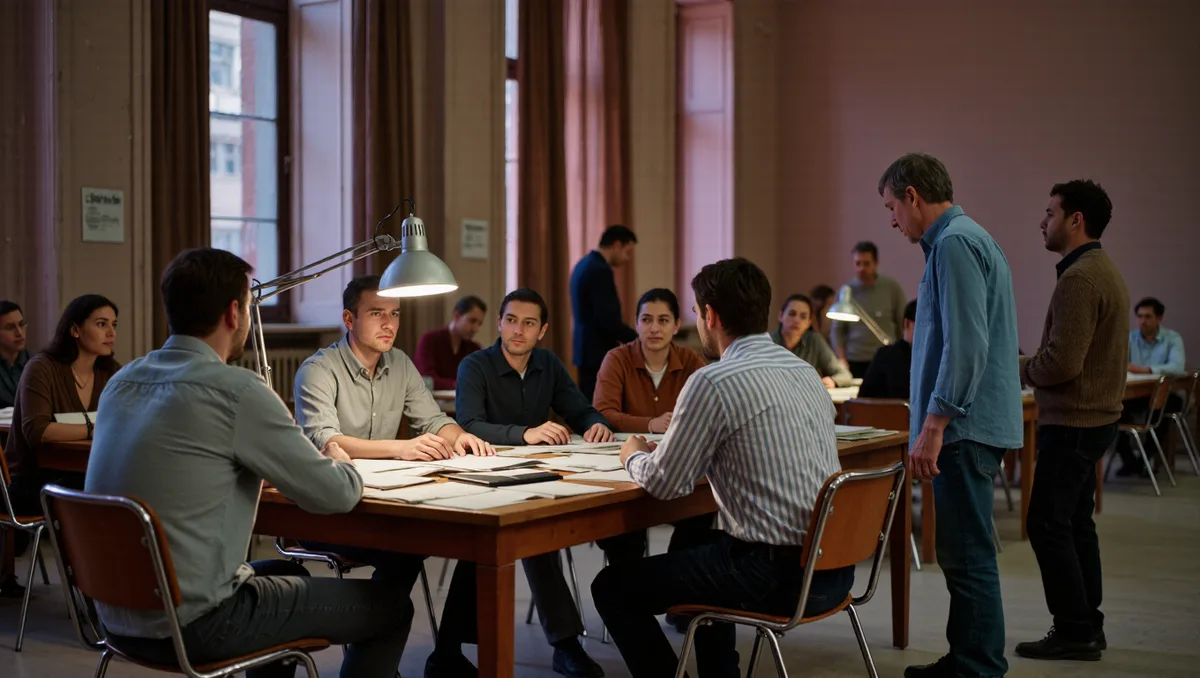
The word covers a wider workforce than most viewers imagine. On a stage production, the backstage crew includes the stage manager, who runs the show once it opens; the assistant stage managers, who track props, entrances and quick changes; the lighting and sound operators, who execute the designer's plan cue by cue; and the fly and rigging crews, who move scenery overhead without anyone below looking up. On a film or television set, the equivalent jobs live in different departments: gaffers run the lighting, grips shape it, script supervisors keep continuity, and production assistants move information between departments at speed. This connects to our earlier piece, The One-Man Anthology: How Mike White Turned Total Authorial Control Into HBO's Most Reliable Emmy Machine.
The common thread is execution under time pressure. Designers imagine; operators deliver, every night or every setup, on schedule. A lighting tech does not get to have an off night. Neither does the person queuing the sound cues, or the dresser standing in the wings with a costume held open for a nine-second change. The craft is repetition performed at a standard, which is a harder thing than it sounds and a far less photographed one.
Why does the audience never learn their names?
Because the economics of attention only reward one layer of the credits. Marketing sells a face. Awards mostly honor the people whose work is legible as authorship — writing, directing, the lead performances. The crew sits below that line, in categories that even dedicated viewers skim past during the crawl. The result is an information asymmetry: the audience can name the star of a show and cannot name anyone who made the star look good.
The industry's own language reflects the gap. The metaphor has traveled far enough that software borrowed it: the developer-portal framework called Backstage, documented by its maintainers on GitHub, was created by Spotify and is now hosted by the Cloud Native Computing Foundation — a tool for organizing invisible infrastructure, named after the part of a theater nobody buys tickets to. When even engineering teams reach for the theater's backstage as their image of essential unseen work, the metaphor has done its job.
What this means for coverage is that the profile has to do the work the credit crawl doesn't. It has to make a career in execution legible as a career — with its own judgment calls, its own apprenticeship, its own bad nights and recoveries.
What does a stage manager actually control once the show opens?
Everything operational, and nothing creative — which is the strange beauty of the job. During rehearsal, the stage manager tracks blocking, records the director's decisions and keeps the schedule honest. Once the production opens, the director leaves, and the stage manager becomes the show's keeper: calling every cue, holding every entrance to the timing the director fixed, and making the hundreds of small nightly calls that keep a performance identical to itself. The job is authority without authorship. The stage manager's name is in the program, usually in small type, and the entire evening runs through their headset.
It is the clearest example of a backstage role where the person is, functionally, running the show. The audience would never guess it. The cast knows exactly who runs it, which is why the traditional opening-night courtesy — the acknowledgment from the stage, however brief — always lands where it does.
How do crews on a television or film set differ from stage crews?
Scale and permanence. A stage crew builds one show and perfects it over weeks, then repeats it nightly. A screen crew builds a new configuration every day: a new location, a new lighting plan, a new set of problems, wrapped and gone by evening. The gaffer who made Tuesday's kitchen scene look like late afternoon will never light that kitchen again. The skill is not repetition but rapid, accurate problem-solving — reading a script page, a location and a schedule, and producing a look that matches the rest of the show.
The screen side also fragments the credit further. A single scene's image is the joint output of the cinematographer, the gaffer, the grips, the colorist downstream and more, which makes individual attribution genuinely difficult. That difficulty is a real reason the audience doesn't know these names; it is not an excuse for the industry not to surface them.
What this means: Practical steps for watching differently
Our analysis is that backstage coverage changes how a viewer watches, and the change is available to anyone. Watch the light before the face: notice where it comes from and what it is doing to the scene. Watch the edges of the frame for continuity — the glass that refills, the coat that reappears — and you are watching the script supervisor's work. In a live-theater broadcast or a taped stage performance, watch the transitions; they are choreographed as tightly as the scenes around them, by people the program lists in small type.
Read the full credits at least once for a show you love. The names there are not filler. They are the workforce this series exists to profile, and the more of them a viewer can attach to a specific craft, the more legible the whole production becomes.
The case for putting crews in the profile chair
The profile form has spent decades treating authorship as the only interesting subject, and it has left a large, skilled, essential workforce on the other side of the page. That is a choice, not a law. The crews behind big productions make decisions every working day that determine what the audience sees; those decisions can be described, contextualized and argued about like any director's. The evidence for their importance is in the work itself: a production that runs clean is a production whose backstage held. The unknown is only how long the industry's attention economy will keep rewarding the marquee over the lattice — and profiles like these are one way of shifting the balance, one name at a time.