Norman Lear did something American sitcoms had mostly been built to avoid: he put the argument on the air. Between 1971 and 1983, the producer's name sat atop All in the Family, Maude, The Jeffersons, Good Times, and One Day at a Time — a run during which, at its mid-1970s peak, his shows occupied a startling share of the Nielsen top ten simultaneously, a concentration of comedic power no single producer has matched since.
What did Lear actually change about the sitcom?
The answer is subject matter, and the mechanism was architecture. The classic American multi-camera sitcom had been engineered for reassurance: a problem introduced, a problem solved, a couch restored to its rightful place in twenty-two minutes. Lear, adapting the British series Till Death Us Do Part with writer Bud Yorkin as his partner, kept the format but replaced the polite furniture with a loud one — a working-class Queens household where a dockworker named Archie Bunker argued about race, war, and women's liberation with his family and lost most of the arguments on the evidence. All in the Family debuted on CBS in January 1971 and became the number-one series in the country for five consecutive television seasons, a streak that remains effectively unmatched.
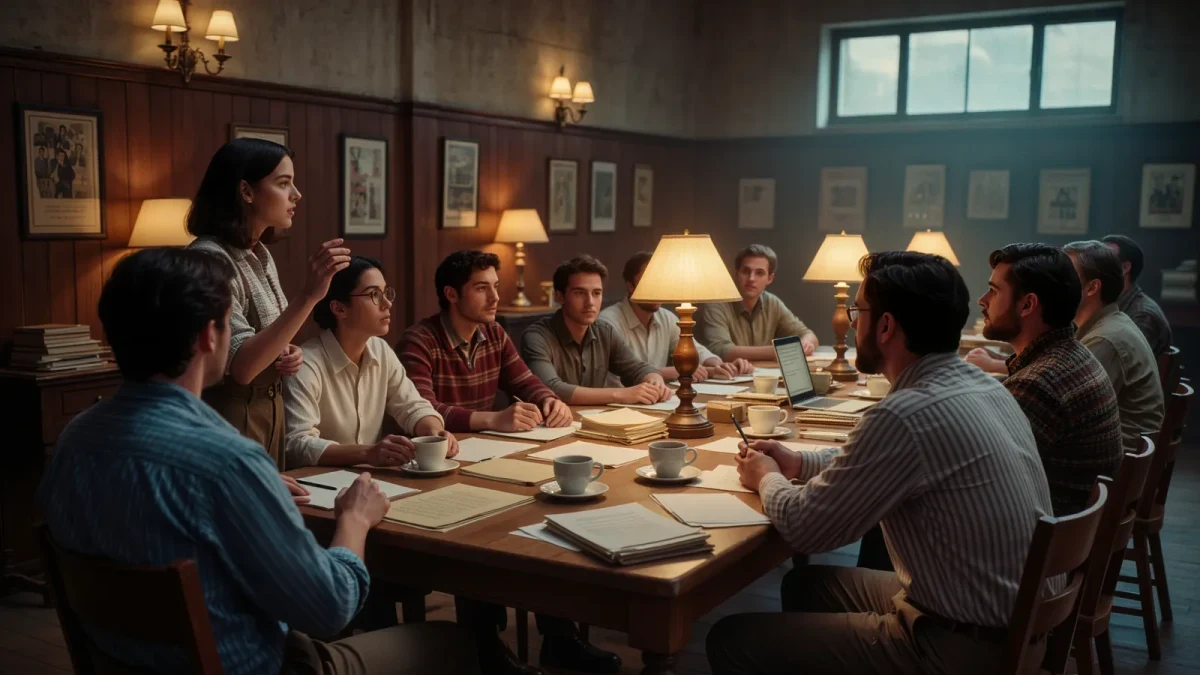
The craft move deserves more attention than it usually gets, because it was not merely provocation. Lear's writers built episodes around genuine rhetorical combat, and the studio audience — filmed, audible, frequently screaming — became a kind of national focus group whose reactions were themselves part of the text. Archie was written to be wrong and to be loved, a balance so difficult that half the country argued over whether the show was mocking him or speaking for him, an ambiguity the production leaned into season after season. That argument, conducted in living rooms rather than by critics, was the product. profiles coverage.
How did one producer end up with half the schedule?
Spin-offs, and an unusual tolerance for discomfort. Maude took Bea Arthur's All in the Family guest character and gave her a series willing to take on alcoholism and, in a famous 1972 two-parter, abortion, years before most dramas would touch the subject. The Jeffersons moved a Black family, played by Sherman Hemsley and Isabel Sanford, uptown to a deluxe apartment and into a run that lasted eleven seasons. Good Times, developed with Mike Evans and Eric Monte, put a Black family in a Chicago housing project and then dramatized the fight behind the scenes over whether that family could catch a break on camera — a fight that previewed conversations the industry is still having. Sanford and Sanford and Son, the Redd Foxx vehicle Lear and Yorkin's company oversaw, rounded out a slate that treated working-class and Black audiences as the mainstream, because numerically they were.
The scale had a cost. Lear's company, Tandem Productions, was running as many as six series at once, and the producer's attention fractured in ways his writers' rooms openly discussed. Good Times in particular generated a public quarrel over creative direction with its star John Amos, and the pattern — a Lear show born in argument, sustained by argument, sometimes damaged by argument — became a case study in what authorship means when one man's name is on that many buildings.
Why did he walk away from the format he owned?
He didn't walk away so much as pivot to a different kind of argument. In 1981, alarmed by the rise of the religious right as a political force, Lear founded People for the American Way, an advocacy organization, and spent much of the decade as a first-amendment activist rather than a sitcom mogul. The instinct was consistent with the work: a man who believed television's dinner-table arguments were a civic good, and who treated an actual political movement as simply a bigger room to shout in. He returned to producing repeatedly — the 2017 reboot of One Day at a Time, built around a Cuban-American family on Netflix, ran three seasons and proved the template still functioned when the arguments were updated rather than replaced.
Then there is the strangest résumé line in television history: in 2000, Lear and a partner paid over eight million dollars at auction for a 1776 copy of the Declaration of Independence, then sent it on a national tour so ordinary citizens could see it. The gesture was pure Lear — a belief that the country's founding arguments belonged to everybody, staged with the showman's instinct that had once put Archie Bunker's chair in the Smithsonian.
What is the Lear method, and who inherited it?
Strip it to its mechanism and the method is simple to state and brutal to execute: find the fight the audience is already having at home, cast it with people who love each other, and refuse to let anyone win too cleanly. The influence runs wider than the usual homage list. Kenya Barris's black-ish is a Lear show in all but paperwork. Norman Lear's own late-career reboots aside, the revival of network family comedy with political friction — a vein running through much of the past decade's comedy development — is a direct tap into the 1971 formula. What no inheritor has replicated is the market position: Lear operated in an ecosystem of three broadcast networks where a number-one comedy reached a majority of the country at once, and part of his legacy is simply proof of what that concentration made possible.
Lear died in December 2023 at 101, working, characteristically, on projects intended to keep the argument going. The honest assessment is that he solved the sitcom by breaking its central promise — the promise that everything would be fine — and audiences, by the tens of millions, thanked him for it. Every family comedy that trusts its viewers to hold two opposed sympathies at once is operating in the space he cleared, and the space has not crowded since.