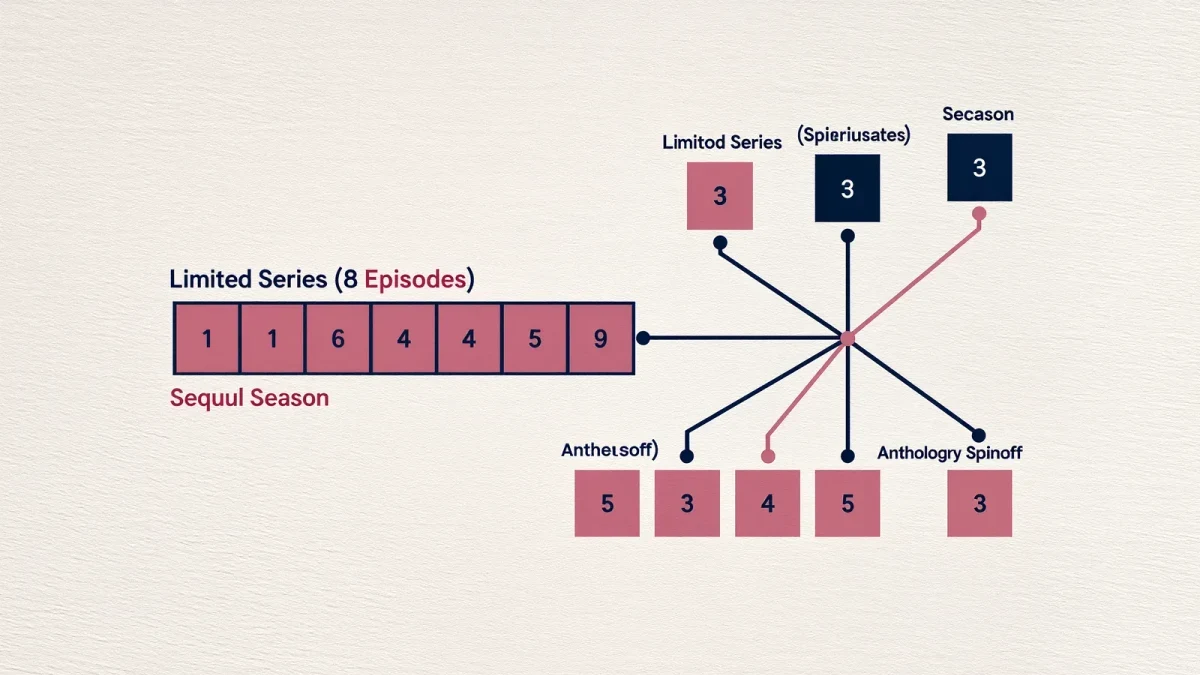
The limited series became the industry's favorite compromise because it resolves, in one format, the three parties' conflicting desires: platforms get awards-adjacent event programming without a multi-year obligation, stars get material substantial enough to leave film for, and audiences get something broadcast rarely promised — an ending. The trouble with compromises is that everyone keeps testing them. The modern limited series is increasingly bent toward second seasons, anthology continuations, and franchise extensions, which is why the format's integrity has become a live industry argument rather than a settled convention.
What is a limited series, formally?
A scripted series with a predetermined, closed story — traditionally a single season of four to ten episodes, no continuation expected or planned. The old broadcast label was the miniseries, a form that peaked in the era when networks programmed multi-night literary epics as sweeps events; the term fell out of fashion and was replaced, in the awards and streaming era, by limited series, a rebrand with real structural consequences. The miniseries was a scheduling spectacle; the limited series is an acquisition strategy. Same closed arc, different business logic.
What does each side get out of the deal?
- Platforms: a self-contained event that markets itself as unmissable, with no expensive long-tail commitment if it underperforms.
- Talent: film-scale roles with film-scale shooting schedules — a few months, one season, no seven-year network contract.
- Audiences: a complete story with a guaranteed finale, sized for a week of viewing rather than a multi-year relationship.
- Awards voters: a category built for prestige adaptations and true-crime dramas, which the industry happily supplies.
Each incentive is rational on its own. Together they made the limited series the closest thing the streaming era has to a default prestige format.
Why does the compromise keep breaking?
Because a hit limited series is an orphaned asset. A platform that owns a successful closed story faces an irresistible temptation: the audience is already there, the IP is already paid for, and a second season is cheaper than launching a stranger. And so the format's most famous recent tradition is the strained sequel — the returning limited series, announced with some narrative contortion, a new subtitle, or a partial cast reset. The industry's workarounds are legion: continue with a new case, jump timelines, follow a different character, reboot as anthology. The audience notices, and the noticing has curdled into skepticism; a limited series tag now functions less as a promise than as a suggestion, and viewers have learned to hedge their emotional investment accordingly. The compromise survives because all parties still profit from it, but its credibility is maintained by damage control.
Why did the format surge in the streaming era specifically?
Short-season economics made it the path of least resistance. A limited series fits a single production cycle, costs a bounded amount, fills a release window, and can be marketed as an event with a date attached — qualities a returning series offers only after renewal risk. It also solved the star problem that television had been failing to solve for decades: the format's single major innovation relative to the miniseries was positioning itself as the acceptable way for film actors to do television, at exactly the moment streaming platforms needed film actors to make television feel like cinema. The limited series is best understood as a diplomatic instrument — a treaty between the film talent market and the episodic machine, written in six to ten episodes.
Is the format's future as a closed form safe?
The honest answer is that the format's future is safe and the promise's future is not. Closed stories will keep being made because they remain the cheapest way to buy prestige, and the awards infrastructure keeps rewarding them. But the label's meaning is drifting under commercial pressure, and the drift will continue as long as one-shot hits remain the industry's most underexploited asset. The viewer's defense is the only durable one: reward the endings that land, notice the contortions of the endings that return, and treat the phrase limited series as a description of ambition rather than a contract. The compromise will hold exactly as long as the audience keeps holding the industry to it.
What did the limited series kill?
The mid-budget returning drama, mostly, and quietly. When the industry's prestige energy shifted to closed eight-episode stories, the shows that used to occupy the middle — solid serialized dramas that ran three to five modest seasons, earned steady if unremarkable numbers, and accumulated syndication value — lost their reason to exist. Streamers do not need library volume the way syndication-dependent studios did, and a closed story is easier to market, cheaper to commit to, and safer to cancel before it embarrasses anyone. Actors liked the deal too: a known endpoint means a movie-shaped commitment with television-shaped exposure, which pulled film stars into series who would never have signed an open-ended contract. What died in the shuffle is the slow-building show, the one that found itself in season three, because nobody orders season three on spec anymore.
Is the anthology stretching the definition?
Aggressively, and the stretching is the business model. If a limited series performs, the owner now faces a choice between leaving money on the table or tainting the promise of an ending — so the industry invented the continuation, the epilogue season, the anthology relaunch that keeps the title and swaps nearly everything else. Audiences have learned to read the phrase based on true events as a genre rather than a claim, and to expect that a sufficiently beloved eight hours will discover, a year later, that there was more story after all. The limited series began as a promise of discipline — no bloat, no decline, a shape — and it survives by breaking the promise selectively, which may be the most honest thing a format has ever done.