The anthology series survived because its weaknesses in the broadcast era became strengths in the streaming one. A format that resets cast and story every season was once a commercial liability — no returning characters to build loyalty around, no long-term cast contracts, no familiar premise to advertise — and broadcast television steadily engineered it out of the schedule. Streaming inverted the math: a reset costs nothing in subscriber retention, attracts stars who will commit to a single season, and generates a fresh marketing event per edition. The anthology was built for a business that changes its product every quarter. It just had to wait for television to become that business.
What is an anthology series, in form?
A scripted series whose stories reset on a schedule — each season, or historically each episode, introduces a new narrative, cast, or setting, with no continuing characters beyond a host or framing device. The format is television's oldest: the mid-century anthology dramas of live broadcasting were the medium's original prestige form, adapting plays and short stories with New York theater actors before Hollywood's genres took over the schedule. The episodic anthology faded as episodic television consolidated around returning characters — the industry learned that audiences bond with people, not premises — and the format retreated into genre niches before returning, decades later, in season-anthology form: one story per season, reset annually.
Why did the anthology nearly die on broadcast?
Because broadcast economics rewarded repetition. A network's asset was a returning audience for returning characters, and everything about the 20th-century television business — syndication packages, cast contracts, advertising rates built on predictable ratings — favored the series that could promise the same product next week. An anthology promised the opposite: novelty, with all its risk. Stars had to be re-cast, writers could not build long arcs, and viewers had to be re-recruited every cycle. The few long-running episodic anthologies that survived did so on brand — a name audiences returned to even when nothing else carried over — which was itself the exception that proved the rule: the format survived exactly where it could behave, from the viewer's perspective, like a returning series.
What changed with streaming?
- Talent access: a one-season commitment fits a film career, so anthology seasons became showcases for actors the episodic grind could never book.
- Event marketing: each reset is a new launch, and platforms that need weekly talking points prefer new events to continuity maintenance.
- Risk containment: an underperforming edition ends by design, with no expensive long-tail obligation or awkward cancellation.
- Flexibility of scale: seasons can vary in length, tone, and genre without breaking format.
None of these advantages would have mattered in a syndication-and-reruns economy. All of them matter enormously in a subscription-and-attention economy, where the product is not a schedule but a stream of events worth subscribing for.
How has the form itself evolved?
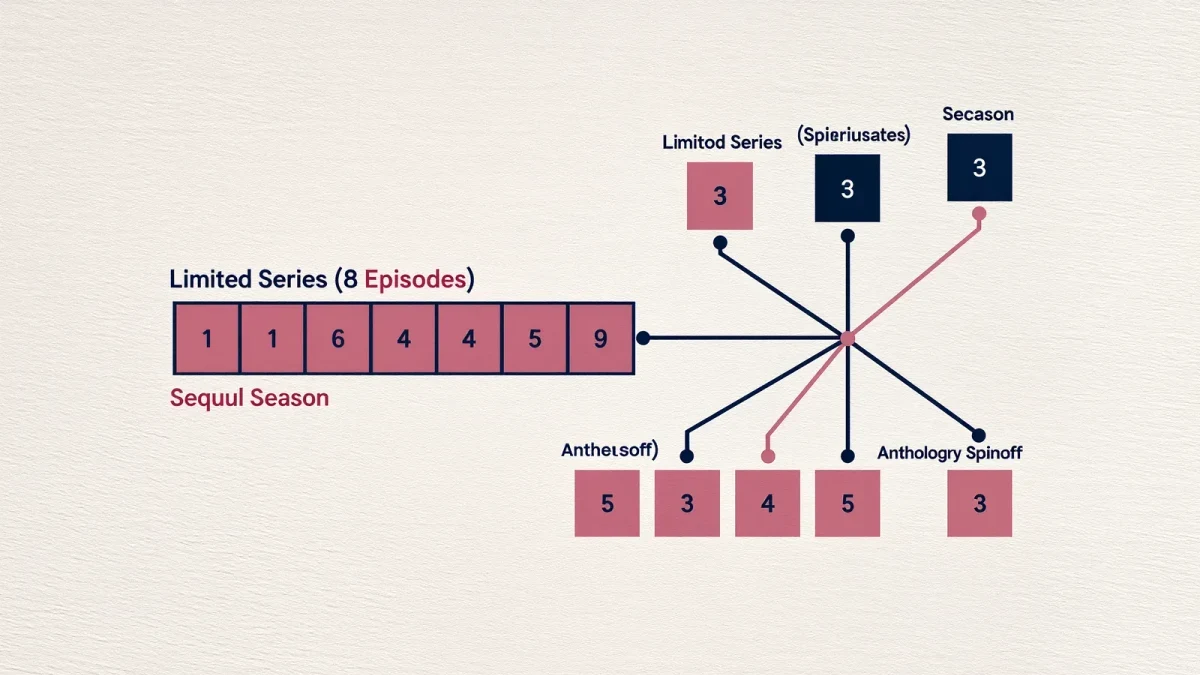
The contemporary anthology has split into subspecies. The season anthology resets story and cast each season. The episodic anthology — largely carried by a single famous brand in the modern era — resets every episode, the oldest form revived with cinematic budgets. The loose anthology connects seasons through a shared universe, franchise, or creative team while changing everything else, a hybrid that buys brand continuity at anthology prices. And the informal anthology — a creator's series of separate limited stories under one title's sensibility — keeps the format's spirit without its letter. The variety is a sign of health: forms calcify when there is one way to do them, and the anthology currently has several.
What does the anthology's survival say about television?
That formats do not die; they wait for their economics. The anthology was pronounced obsolete by an industry organized around character continuity, and revived by an industry organized around talent events and subscription churn. Its survival also corrects a lazy assumption about audiences — that viewers will only follow people. The anthology's modern success demonstrates that viewers will follow a sensibility: a tone, a level of ambition, a promise about the kind of story arriving next. That is a deeper loyalty than a cast contract, and harder to build, which is why the format's failures are as common as its triumphs. But the ceiling is high. The anthology's promise — every season a new world, nothing owed to the last one — remains the most generous promise television makes, and the streaming era, alone among television's economies, can afford to keep it.
Why does horror love the anthology most?
Because horror's unit of value is the idea, not the character. A monster, a twist, a dread that resolves in twenty minutes — that is a complete transaction, and stretching it across ten hours dilutes exactly what the audience came for. The anthology lets horror run at the speed of its own scares: new premise, new cast, new trap every week, with a recognizable brand on the door so the audience knows the rules of the game without a pilot teaching them. There is also a casting logic the format quietly mastered — a star will give an anthology a week that they would never give a series a season, which is why the guest roster of any successful horror anthology reads like a talent agency's holiday card list. The genre keeps the format honest, too: an unfunny comedy segment is merely flat, but a horror segment that does not land is dead air with a body in it, so only the versions of the machine that work survive.
Is the weekly-story anthology coming back?
In patches, and mostly outside the places that invented it. The classic case-of-the-week machine depended on broadcast economics that no longer exist, but the format keeps resurfacing wherever a buyer needs a show that can be entered at any point — international co-productions, ad-supported streamers, the fast channels that run all day in the background of people's homes. The binge model was hostile to the weekly story, since an anthology asks you to reset every hour and a binge asks you never to leave; the newer, free platforms are indifferent to your attention span in a way that turns out to favor it. What the format has always offered is a truce between commitment and novelty: no continuity homework, no season-long promise, just a fresh premise and an exit. Television keeps rediscovering that this is a perfectly good reason to watch.