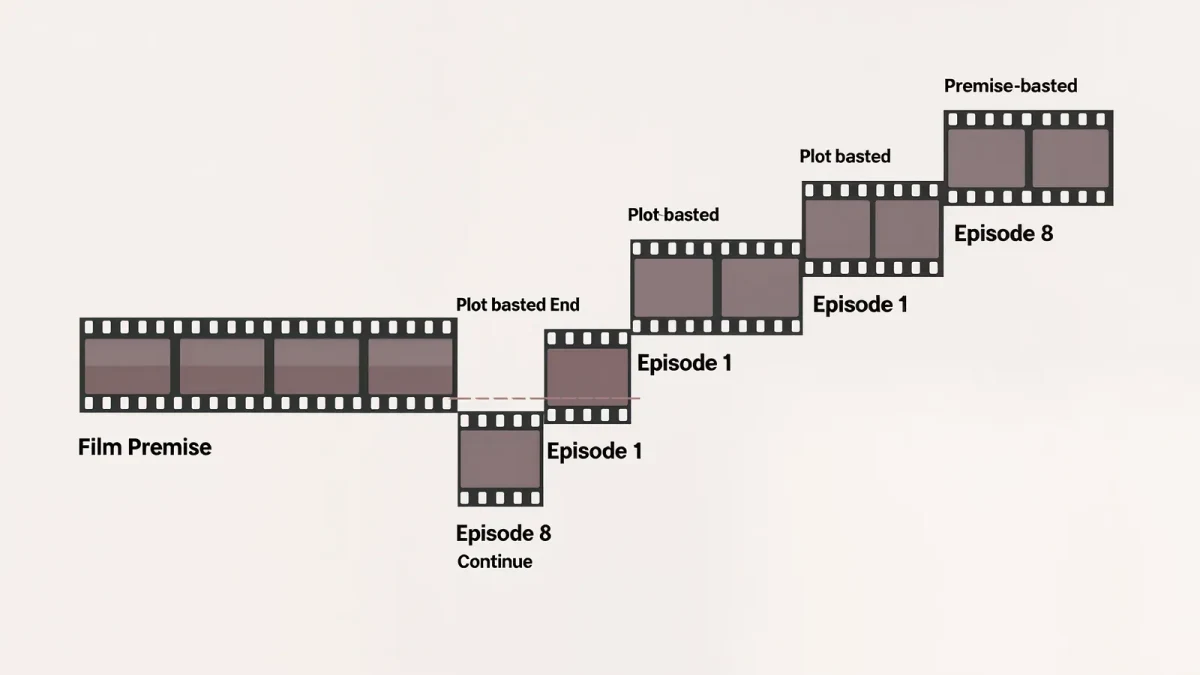
Film-to-TV adaptations usually fail because they mistake a premise for a story: a movie is a machine built to exhaust its idea in two hours, and a series is a machine built to sustain one for years. When a network or streamer buys a film title, it is usually buying brand recognition, which is a marketing asset and not a narrative one. The adaptations that endure — and there are famous ones — are almost always the ones that kept the premise and discarded the plot, treating the film as a setting bible rather than a blueprint. That distinction, more than talent or budget, predicts outcomes with uncomfortable reliability.
This piece is criticism and business analysis of a format pattern, based on the public record of shows and their receptions; it is not an evaluation of any individual creator, who after all is usually handed the premise and told to make it a franchise.
Why does a two-hour story resist becoming a series?
Because movies are structured around depletion. A film spends its dramatic capital — the mystery, the romance, the confrontation — at a rate calibrated to 120 minutes, and the ending pays it off precisely because there is nowhere left to go. Television runs on the opposite physics: it defers payoff, banks conflict, and needs characters whose problems regenerate. Adapting a film directly means stretching depleted material, which is why so many movie-derived shows spend their first seasons remaking the movie at quarter speed, then inventing a second season nobody asked for. The audience's affection for the film becomes a debt the series must service, and interest compounds. Add the casting problem — replacements for beloved film performances arrive pre-resented — and the format starts to look like a bet against arithmetic.
What separates the failures from the exceptions?
The failures, a list every development executive can recite from memory, share one trait: they adapt the film. The exceptions share the opposite one. The television version of Fargo kept a regional milieu, a tonal signature, and a moral worldview, then told entirely new stories with new characters in each season — an anthology logic the film never needed. What We Do in the Shadows kept a comic premise (documentary-crew vampirism) and let television's episodic rhythms regenerate the joke weekly. Westworld, whatever one thinks of its later seasons, expanded a premise rather than replaying a plot, which is why its first season worked before its mythology collapsed under different pressures. The pattern: adaptation-as-anthology or adaptation-as-premise succeeds; adaptation-as-sequel limps; adaptation-as-remake dies.
There is also a structural reason the exceptions cluster on cable and streaming rather than broadcast. A premise-forward adaptation needs tonal control and a fixed endpoint, which are things the limited series and the anthology — formats the streaming era made respectable — provide and the 22-episode network order does not.
Why do studios keep ordering them anyway?
Because the failure rate is priced in. A known title lowers the marketing cost of launching a show, and in an era when launching anything is the most expensive part of the equation, a pre-aware premise is worth a lot of structural risk. The economics have been reshaped by the same IP logic that drives franchise cinema, a shift covered exhaustively in industry business reporting, including the long-running trade coverage at BBC Culture on adaptation trends. A studio that owns a film library owns, in the current accounting, a development slate; the film-to-series pipeline exists because catalogs became content strategies. Most of those shows are expected to be adequate. Adequate, with a familiar name attached, pencils out.
How should a viewer spot the difference before committing?
The tell is in the credits and the commission, both of which are public. An adaptation that names a showrunner with real authority and a specific creative reason for existing — a premise the film only explored for one act, a world the film visited for one location — is announcing that someone wanted to write television. An adaptation whose entire pitch is the title, announced in the same breath as a slate of five other vault projects, is announcing that someone wanted to fill a quarter. The casting confirms it: a premise-forward adaptation builds a new ensemble, while a title-forward one hires a lookalike and hopes the nostalgia does the rest. None of this guarantees quality, since television defeats good intentions weekly. But it predicts the failure mode with decent odds, and a viewer who learns to read the announcement has already done more analysis than the greenlight meeting did. The film-to-series pipeline, which En Rose treats as a standing beat, will keep producing both kinds. The skill, for the audience, is learning which is which before the pilot rather than after.
Is the format getting better or just more frequent?
Both, and the second is causing the first. As the pipeline crowded, the adaptations that cut through stopped being the reverent ones and became the genuinely transformative ones — the series that treat the source film the way a good cover treats a song, keeping the melody and changing the key. The lesson the industry has slowly learned, at the price of a decade of canceled-once-removed franchises, is that audiences do not want more of a movie's story; they want more of a movie's feeling. When a series delivers the feeling, the title on the poster stops being a debt and becomes an asset. When it doesn't, no amount of familiarity saves it. The premise was never the problem. The plot was, and the fix, it turns out, was simply to write a television show.