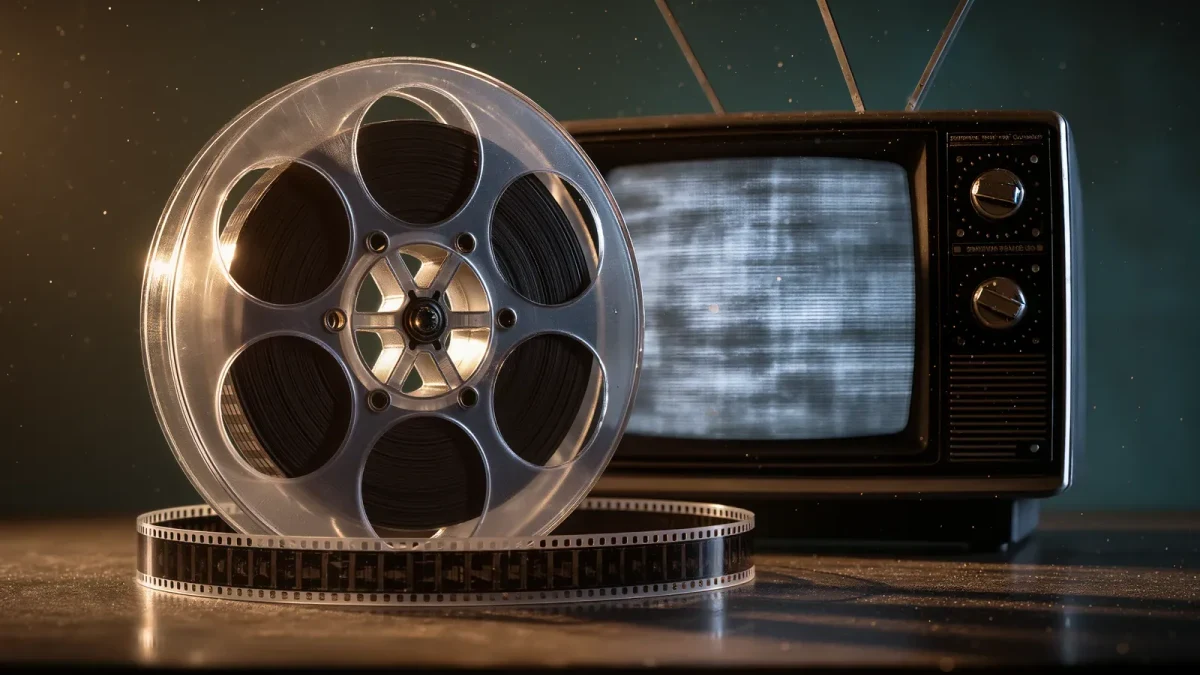
The made-for-TV movie was a scheduling solution that became a genre: a film produced expressly for a network's primetime lineup, cheap enough to justify its existence and occasionally good enough to embarrass the theatrical competition. Born in the 1960s, dominant through the '70s, defensive through the '80s and '90s, and finally reborn as the streaming original, the form is the clearest record television keeps of how it saw itself — a farm league, a demagogue, a public service, and eventually a prestige venue, all wearing the same 90-minute-with-commercials dress.
What follows is a history drawn from the public broadcast record, a story about formats and scheduling logic rather than any individual filmmaker, most of whom were working exactly as hard as the form allowed.
Where did the made-for-TV movie come from?
From a hole in the schedule. Networks in the 1960s needed programming that cost less than a series and filled a night better than a rerun, and a self-contained film — shot fast, aired once or twice, then shelved — fit the arithmetic. ABC's aptly named wheel of weekly originals turned the format into an institution in the late 1960s, and the economics came with an aesthetic: videotape-flat lighting, ensemble casts of contract players, and stories that could be summarized in one logline. But the form's reputation as filler undersold what the constraints produced. Cut off from spectacle, the television movie leaned on issue drama — illness, prejudice, addiction, the headlines of the week — and by the early 1970s it was routinely outdrawing theatrical films on the nights it aired. A 1971 football weepie about a dying athlete and his friend became one of the most-watched television films of its era and is still cited as the format's artistic high-water mark; the industry's own archival retrospectives, including pieces at BBC Culture on television history, keep returning to that stretch of years as the moment the form briefly mattered more than the movies.
Why did the networks stop making them?
Because the format's economics inverted. Cable arrived in the 1980s offering movies without edits or commercials, and the theatrical titles the networks had licensed for decades got more expensive while losing their event status. The television movie's response was volume-disaster: real-life scandal melodramas and true-crime quickies, shot in weeks to chase headlines, which kept the ratings math working while hollowing out the form's credibility. The '90s brought a late flowering — social-issue dramas that dominated Emmy categories, the occasional phenomenon — but the audience was already drifting. What survived the network era survived by specializing: the cable TV movie found awards-season respect in the 2000s and 2010s, while the holiday-romance industrial complex demonstrated, with unsettling efficiency, that the form's old scheduling logic still worked if you aimed it at December.
Did the made-for-TV movie actually die, or just change clothes?
It changed clothes. The streaming original film is the network television movie with a nine-figure allowance — a feature produced by a platform to fill its own schedule, promote its own brand, and keep subscribers from canceling between series. The lineage is direct: the same self-contained, library-building, cost-controlled logic that filled ABC's 1969 calendar fills a streaming service's release grid in 2026. Even the issue drama returned, rebadged as the awards-bait limited-adjacent feature. The camp wing migrated too — the deliberately absurd creature-and-weather title, once a cable-August staple, became an internet-era ritual and then a brand of its own. What genuinely died was the shared appointment: the television movie once commanded a single national timeslot by definition, and no format born of broadcast could survive that definition intact once the schedule dissolved. The form that invented itself to fill a hole in primetime ended up filling a hole in a content library, which is the same job described in the language of a different era.
What did the TV movie teach the rest of television?
Constraints that turned out to be transferable. The form's budgets forced it toward dialogue, issue drama, and character — exactly the muscles the prestige era later built its reputation on — and its self-contained format taught writers to close a story in 90 minutes, a discipline the modern limited series rediscovers every time a showrunner insists on an ending. The TV movie also pioneered casting against type, giving film stars past their studio prime and theater actors without movie careers the best roles of their lives, which is the same labor market the streaming limited series runs on now. Even the holiday-movie industrial complex carries a lesson: it proved that a formula repeated with total sincerity will find an audience that returns annually like migratory birds, which is loyalty no algorithm needs to predict. The form was television's workshop — cheap, fast, disposable in theory — and its techniques graduated upward every time the industry needed them. The workshop closed, but only because the whole factory got rebuilt around what it discovered there.
What does the format's history actually tell us?
That television's cheapest formats are where its honesty lives. The made-for-TV movie never had the budget to lie about its intentions: it was made to fill air, win a night, or make a point before the news came on, and when it overachieved, it did so through writing and casting rather than scale. The prestige era talks a great deal about television's maturation; the TV-movie's fifty-year run is the quieter proof, a form that went from schedule filler to Emmy staple to streaming flagship without ever changing its essential job. Cheap thrills, it turns out, were never the ceiling. They were the floor plan.