A hit movie now means one of two unrelated things: either it sold tickets, a public and independently countable act, or it was watched on a platform, a private measurement the platform reports itself. Those two kinds of hit are not convertible, comparable, or equally verifiable, and the industry's decade-long effort to pretend otherwise is the quiet definitional crisis underneath every streaming-era press release. Box office is a receipt. Streaming success is a claim. Understanding what a hit means now means understanding who is counting, and why.
This is an explainer on industry measurement, not media-investment advice; the numbers described are the public record of industry reporting.
What does the box office actually measure?
Tickets, counted at the point of sale and aggregated by independent tracking firms whose figures the whole industry, including rival studios, accepts. It is the rare entertainment metric with external auditability: a dollar figure, a per-theater average, a weekend ranking that anyone can compare across decades. Its limits are equally clear — it measures spending, not satisfaction, and says nothing about who watched or how attentively. But as a shared language it is unmatched, which is why even streaming-native companies report theatrical grosses for the films they do release to theaters, and why a box-office number can still end an argument. When a studio says a movie opened to a certain figure, that statement is falsifiable. Almost nothing else in the modern measurement stack is.
What do streaming metrics actually measure?
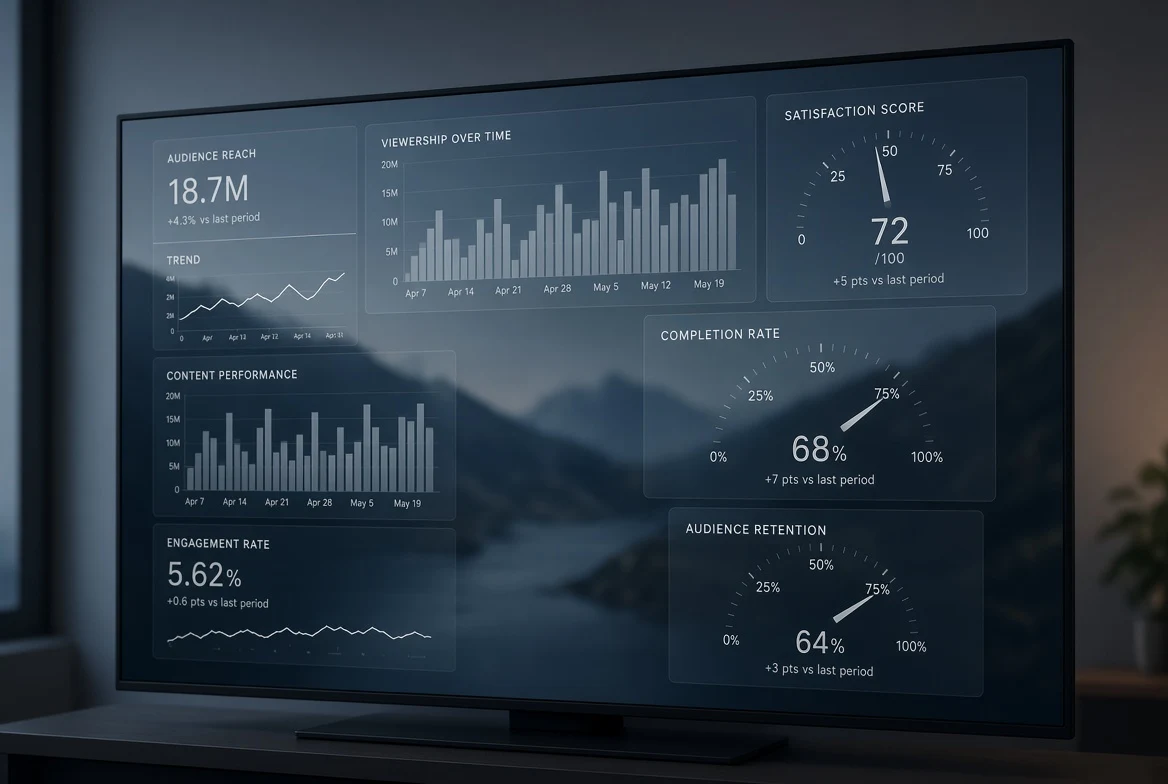
Attention, self-reported, in units the platforms choose. The dominant public metric became total hours viewed, published in periodic engagement reports that rank titles by watch time over fixed windows — a genuine improvement in transparency over the subscriber-acquisition claims of the 2010s, and still a metric with the fox's pawprints on the scale. Hours viewed rewards length, which is why a long-running series dominates those rankings in a way no per-viewer measure would; it says nothing about completion, satisfaction, or whether the viewing household was asleep. The platforms have their internal complements — completion rates, household reach — that they cite selectively and never fully publish. None of this is conspiratorial; it is simply what measurement looks like when the auditor and the audited share a parent company, a structural quirk covered at length in media-business reporting, including the streaming-metrics coverage at Bloomberg Media.
Why can't the industry just pick one standard?
Because each metric serves a different master, and the masters are now often the same companies playing both sides. A studio that releases a film in theaters for six weeks and then moves it to its own streaming service benefits from the box-office framing in phase one — externally verified, culturally legible — and the engagement framing in phase two, where the same title becomes proof the platform is working. The result is a rhetorical style best described as metric-shifting: a film is a box-office story when the gross is flattering, a streaming story when the hours are, and a 'global phenomenon' when the press release can blur the seam. The trade press, to its credit, keeps flagging the category errors, and third-party estimators have built businesses modeling streaming performance from outside the walls. But the fundamental asymmetry stands: theatrical performance is a fact about the audience; streaming performance is a fact about a company's own dashboard.
How do trade reporters cover hits without a shared yardstick?
With visible effort and an emerging set of conventions. Box-office stories cite the independent trackers and end there, since the figure speaks for itself. Streaming stories have learned to quote the platform's published engagement data with attribution and caveats — a top-ten placement, an hours-viewed milestone, a 'most-watched in the service's history' claim that is only as good as the service's willingness to define 'watched.' Third-party measurement firms, sensing the gap, built panels and analytics that model streaming audiences from the outside, the way ratings services once measured networks, and their estimates now appear alongside platform claims with the implicit framing of a second opinion. The result is coverage that reads like bilingual reporting from a country with two official numbers, and the better reporters are scrupulous about never translating one into the other without a label. The audience should be equally scrupulous: a box-office figure and a hours-viewed figure can both be true and still say nothing comparable. A hit is what the measuring company says it is, and the measuring companies no longer agree on what they are measuring. That, more than any single number, is the defining measurement fact of the era.
Does any of this change what gets made?
Profoundly. When success was box office, the industry optimized for openings — spectacle, franchises, marketing scale. When success is engagement, the optimization target becomes time-on-platform: long series, bingeable catalogs, films that perform adequately forever rather than explosively once. This is why the movies that used to be mid-sized theatrical bets — the adult drama, the comedy, the original thriller — migrated to streaming, where an adequate premiere that retains subscribers is a success the theatrical math would have called a failure. It is also why the theatrical survivors are the extremes: the event film that can still command a shared opening weekend, and nothing in the middle. The definition of a hit didn't get fuzzier. It got bifurcated, and each half of the business now speaks its own dialect with total confidence. The audience, meanwhile, has quietly settled the question personally: a hit is whatever they finished, on whichever screen, whether or not anyone managed to count them.