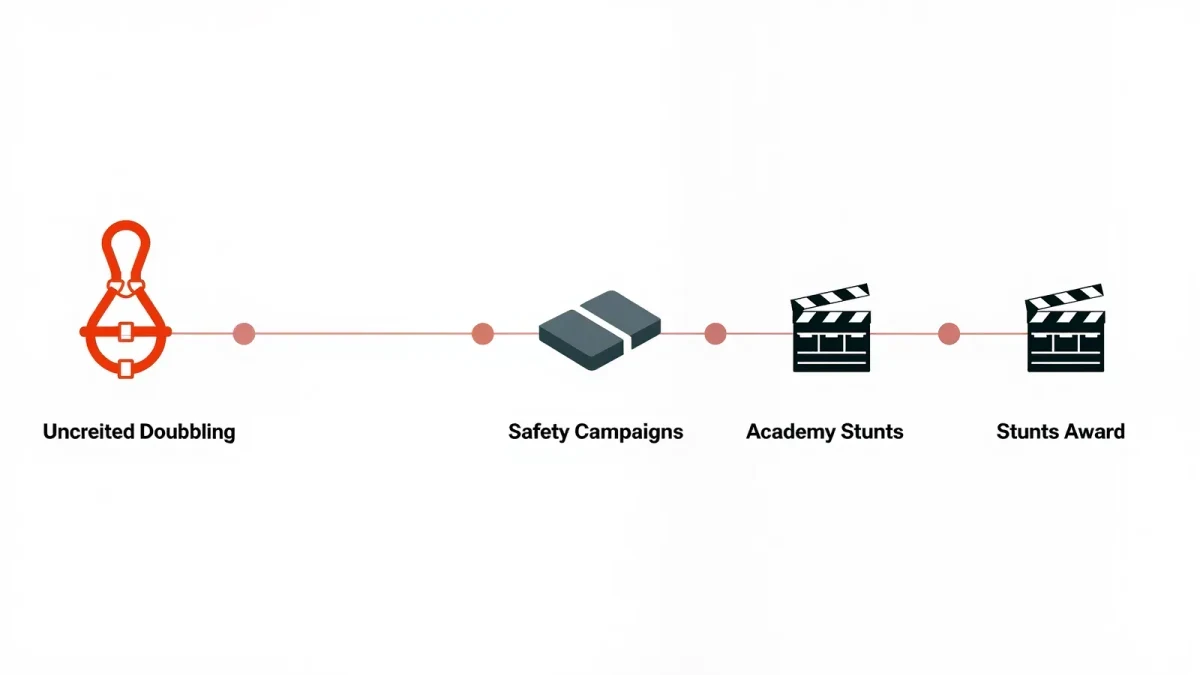
Stunt performers spent decades fighting for on-screen credit because the industry's default was to make them invisible: their work is deliberately shot to be mistaken for the star's, their names were historically buried or omitted entirely, and the highest honor their craft could win was, for ninety-plus years, an awards category that did not exist. That last part began changing when the Academy announced a new Oscar for achievement in stunts, with first presentation set for the ceremony calendared in 2028 — a decision reported across the entertainment press, including Reuters and the BBC, after years of campaigning by stunt professionals. Credit is finally arriving. The fight explains why it took so long.
Why weren't stunt performers credited in the first place?
Because the illusion demands it. A stunt double exists to be indistinguishable from the actor they replace — same silhouette, same wardrobe, same haircut, arranged in coverage that hides the swap — and a credit reading 'stunt double for the lead' punctures the fiction the scene is selling. The economics reinforced the aesthetics: for most of film and television history, stunts were a blue-collar trade inside a glamour business, staffed by performers who broke bones at a pace that made the absence of recognition look less like an oversight and more like a policy. Television compounded the problem by volume. A weekly action series burns through fights, crashes, and falls on a network schedule, which means years of invisible doubling with none of the contractual credit machinery that performers' other collaborators — writers, directors, even the caterer — could rely on to get their names on screen.
What does a stunt coordinator actually do?
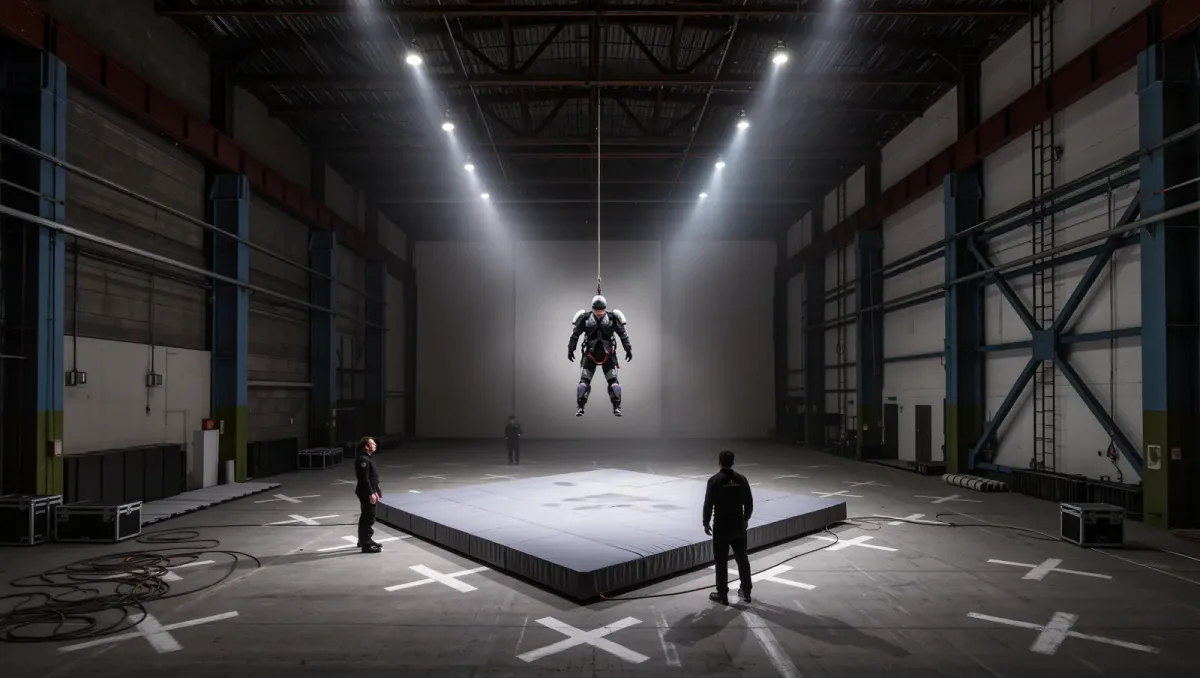
They are the head of the action department and the person legally responsible for its survivability. A stunt coordinator designs every piece of physical action on a production — choreographing fights, planning car work and wire rigs, rehearsing falls — and supervises the stunt team that executes it, alongside managing safety protocols, risk assessments, and the interface between what the director imagines and what physics permits. It is a department-head job with department-head liability, which is precisely why the fight over recognition centered on it: the argument that action design is a craft discipline, not a service, is easier to make about the person who plans the sequence than the performer whose face is digitally replaced by the star's. The coordinator became the credit fight's vanguard by seniority, the way directors once carried the authors-of-the-film argument for the whole above-the-line crew.
The craft's invisibility has a technical component that deserves naming, because it explains why audiences underestimated the discipline for so long. A great stunt is engineered to read as ordinary: the fight that looks like two actors improvising is a rehearsed sequence with counted beats, hidden pads, and camera angles doing safety work; the fall that looks like a mistake is a rehearsed trajectory onto a prepared surface. Good stunt work hides its own difficulty by design — the same sleight of hand that makes editing and sound design invisible — which means the profession spent decades being penalized by its own excellence. Audiences cannot celebrate what they cannot see, and the stunt community's public campaign, years of behind-the-scenes footage, convention advocacy, and social-media education, has essentially been an effort to un-disappear the craft on the audience's behalf, one viral rehearsal clip at a time.
How dangerous is the job, really?
Dangerous enough to have an obituary file. The industry's safety record includes fatalities on sets going back to the silent era and continuing into recent productions, a history of workplace deaths that entertainment-industry reporting has revisited each time another one occurs, and injuries remain routine — a working stunt performer's career is measured, like an athlete's, in surgeries. That physical toll is the moral core of the credit fight: professions that risk bodies for the product usually get their names on it, from test pilots to bullfighters, and the stunt community's argument was never that they were starved for fame. It was that a craft with a mortality rate should at least appear in the credits it makes possible.
What changed the industry's mind?
A lengthening list of factors, none of them sudden. Action storytelling became the dominant commercial vocabulary — franchise spectacle, prestige action series, and a streaming arms race that scaled up set-piece ambition — which made stunt design more visible and more discussed by audiences who now watch behind-the-scenes choreography videos for fun. The community organized, coordinated through the stunt community's own advocacy and its unions' safety and recognition campaigns. And the Oscars, after years of public calls for a stunts category — a campaign the Academy itself acknowledged in announcing the award — agreed to create one. The decision matters beyond the trophy: an Academy award confers category legitimacy on the craft, which historically translates into contractual standing, credit demands, and a seat at the table where sequences are designed rather than merely executed.
What does the new Oscar actually fix?
Less than the name suggests, more than the cynics expect. The award, as announced, honors achievement in stunts at the film level; it does not by itself put a television double's name in a weekly credit sequence, retroactively or otherwise, and television stunt recognition remains a matter of contract and custom. But categories have a way of dragging contracts with them. When a discipline becomes an Academy-recognized craft, the professionals who practice it gain the standing to demand credit, compensation, and safety provisions negotiated from legitimacy rather than sympathy. The doubling problem — the structural irony that stunt work is punished for being too good, since the better the illusion, the more the performer disappears — will never fully dissolve. It can, however, be balanced on the other side of the ledger: the fall still erases the performer, but the credit, the category, and the craft standing finally record that somebody was there.