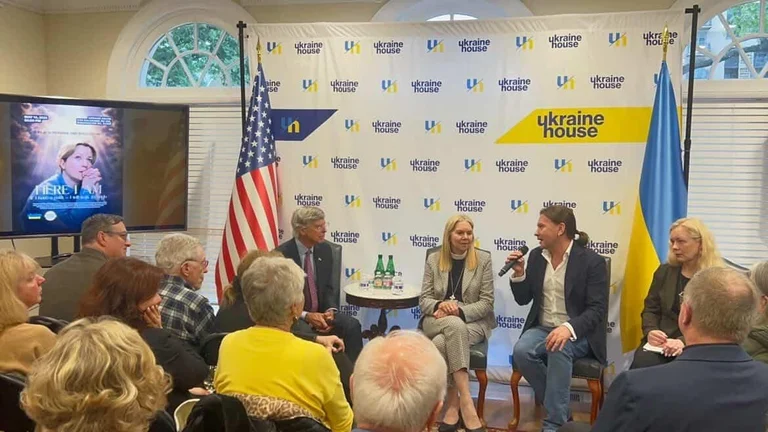
After more than two decades working with comedy and storytelling, Oleksandr Gorbatyi is applying the same understanding of narrative to creative production across film, media and fashion projects in the United States.
When Oleksandr Gorbatyi began working with comedy more than two decades ago, the work was practical: writing, performing and learning how audiences respond to a story in real time.
Over the years, that experience expanded into screenwriting, television and production. In 2025, it also became the basis for Semiotic Comedy, a book in which Gorbatyi attempted to systematize some of the principles he had been using professionally — particularly the relationship between context, audience expectation and reinterpretation in humor.
A year later, his work in the United States was increasingly focused on another area: creative production.
Projects in film, media and the fashion environment, including work connected with Miami Fashion Week and New York Fashion Week, placed Gorbatyi in settings that might appear far removed from comedy writing.
For him, however, the underlying task remained familiar: understanding what story is being told and how an audience will perceive it.
“Storytelling has remained the constant,” Gorbatyi says.
“What changes is where you apply it.”
Learning Through Audience Reaction
Gorbatyi’s background in comedy has had a lasting influence on the way he approaches creative work.
Comedy provides unusually direct feedback. An audience responds immediately, making timing, context and expectation visible in ways that are sometimes less obvious in other genres.
That experience led Gorbatyi to become interested not only in writing humorous material, but in understanding the mechanisms behind it.
In 2025, he published Semiotic Comedy — A Methodology for Constructing Humorous Narrative Based on Sign Systems and Context.
The book examines humor through semiotics, focusing on how audiences interpret signs and context, form expectations and then respond when those expectations are disrupted or reinterpreted.
Gorbatyi subsequently developed the subject in academic work.
His 2025 paper, From Stage to Screen: Applying Semiotic Comedy in Modern Entertainment Formats, examined how these mechanisms change when comedy moves from traditional performance to screen and digital formats.
Another paper, The Role of Semiotics in Humor Transmission and Audience Engagement, focused on the relationship between semiotic mechanisms, humor and audience engagement in digital communication.
The research represents a more formal extension of questions that emerged from his practical work: why does one narrative decision produce a response while another does not, and how does context alter the way audiences understand the same material?
For Gorbatyi, these questions are relevant beyond comedy.
They also influence the way he approaches production.
Moving Toward Creative Production
Creative production became a larger part of Gorbatyi’s professional work as his projects expanded beyond writing.
The transition was not necessarily a departure from screenwriting. Instead, it required looking at narrative from a wider perspective.
A screenwriter is primarily responsible for what happens within a story. A creative producer has to consider how the concept translates across multiple elements of a project — performance, visual language, video, music, casting, location and promotional content.
This has become an important part of Gorbatyi’s work in the United States.
Rather than treating writing and production as unrelated disciplines, he views production as another stage in the development of an idea.
The question changes from
“What should happen in this scene?”
to “How should the entire project communicate its idea?”
That shift has also taken him into an area that was not an obvious part of his earlier career: fashion.
Miami and the Fashion Environment
Gorbatyi’s work around Miami Fashion Week brought his experience with screen storytelling into a visually driven environment.
His responsibilities included creative concept development, overall creative vision, on-site creative supervision, promotional media content and participation in scenario development for video materials.
The work required a different vocabulary from traditional screenwriting, but many of the underlying decisions were recognizable.
What is the central idea?
What should the audience see first?
What tone should the project establish?
How should individual images work together rather than simply exist as separate pieces of content?
For Gorbatyi, this was where the connection between screenwriting and creative production became particularly practical.
Fashion did not become a replacement for film or television. It became another environment in which narrative structure could be applied.
From Miami to New York
In 2026, Gorbatyi’s work in the U.S. fashion and media environment also extended to projects surrounding New York Fashion Week.
The New York setting added another dimension to that work because fashion there exists in close proximity to media, entertainment and business.
Rather than positioning himself as a fashion designer or attempting to build a separate identity within the industry, Gorbatyi has approached fashion from the perspective of a writer and creative producer.
His interest is primarily in how a designer, collection or event can be translated into a story for an audience.
That distinction is important.
It also explains why his work in fashion has begun to move back toward screen content.
Turning the Fashion Industry Into a Story
In 2026, Gorbatyi became involved in the development of an original short-form vertical series set within the fashion industry.
The project combines elements of comedy and drama with the business relationships behind fashion. Its characters include models, designers, producers and investors.
The format brings Gorbatyi’s more recent production experience together with his earlier work as a screenwriter.
Instead of presenting the fashion industry exclusively through runway imagery, the series focuses on the people and decisions behind it: competition, ambition, business interests and the choices that determine who receives an opportunity.
It is also an example of how Gorbatyi’s work has developed in a circular rather than linear way.
Experience in screenwriting led to production.
Production introduced new professional environments.
Those environments, in turn, became material for new stories.
Recognition and Cultural Work
Alongside his screen and production work, Gorbatyi has received several international distinctions.
In 2025, he received the Worldwide Cultural Diplomacy Award from the World Order of Cultural Diplomacy.
His other distinctions include the Order of Honor (“Leaders of the 21st Century”) and recognition as an Ambassador of Cultural Diplomacy.
In 2026, Gorbatyi received the Creative Excellence in Cultural Storytelling Award at the LAZIN Magazine Awards in Paris.
The latter is particularly relevant to the direction of his recent work because it places storytelling within a broader cultural context rather than limiting it to a particular medium.
Gorbatyi’s professional activity has increasingly taken place between countries and creative environments, particularly Ukraine, Europe and the United States.
That experience has also influenced his interest in how stories are interpreted by audiences with different cultural backgrounds — an issue closely related to the ideas explored in his work on semiotics.
One Competence, Different Applications
At first glance, Gorbatyi’s work in comedy, screenwriting, academic research, creative production and fashion may suggest several separate careers.
A closer look shows a narrower trajectory.
The central competence has remained storytelling.
What has expanded is the range of environments in which it is applied.
Comedy provided an early understanding of audience reaction.
Screenwriting provided structure.
Research offered a way to examine some of those mechanisms more systematically.
Creative production expanded the focus from the written story to the complete presentation of an idea.
And work within the fashion environment provided a new visual and commercial context in which to apply those skills.
Gorbatyi does not see that development as a move away from writing.
He sees it as a broader definition of what a writer’s understanding of narrative can be used for.
As media formats continue to change — particularly with the growth of short-form and vertical content — the boundaries between writer, producer and content creator are becoming less rigid.
For Gorbatyi, that evolution is already part of the work.
After more than two decades of working with stories, the medium is changing.
The central question is not.
What is the story — and why should the audience care?