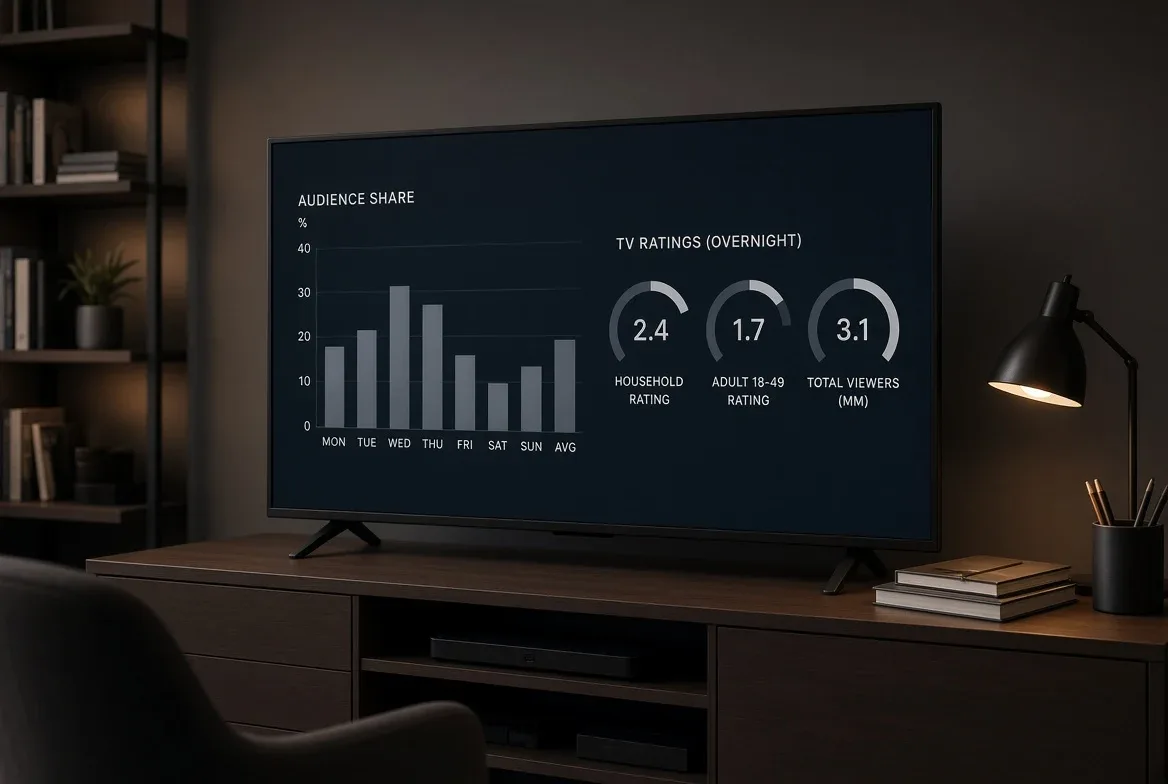
A show survives less because audiences loved it than because a specific, external number gave the network or streamer a defensible reason to keep paying for it — and for most of the industry, that number still comes from Nielsen. Streaming platforms have their own internal viewing data, but the business runs on a shared, third-party benchmark, and understanding how that benchmark is built explains more about renewals than any fan campaign does.
What is Nielsen actually counting? Nielsen measures household and person-level viewing across live TV, playback, and streaming, expressed as totals or as shares of overall watch-time. Its published Top 10 rankings break weekly streaming viewing into three separate lanes — original series, acquired titles, and movies — using total minutes viewed by persons two and older, according to Nielsen's own data-center documentation.
Those weekly rankings are only the visible layer. Underneath them sits Nielsen's household panel, a representative sample whose members' viewing is tracked directly, which the company uses to calibrate a much larger pool of automated data from set-top boxes and connected TVs. Nielsen has described the purpose of combining the two as improving data quality "to ensure more robust data that captures even the smallest audiences," since panel-only samples struggle to catch niche or fragmented shows reliably.
Why do streamers, who have their own numbers, still answer to Nielsen? Because a platform's internal viewing data is self-reported and unverified by anyone outside the company, which makes it useless as a shared currency for advertisers, affiliates, and rival networks who need a number they can compare. Nielsen's status as an independently accredited third party is what lets competing companies agree on the same scoreboard.
This matters most for ad-supported programming, where the number sold to advertisers has to hold up to outside scrutiny, and least for a platform's highest-budget prestige titles, which are often greenlit and renewed on strategic grounds — awards positioning, a showrunner's overall deal, a franchise's long-term value — that a single rating can't fully capture. Between those two poles sits the bulk of a network's or streamer's slate, where an externally verifiable number is the difference between a renewal case a finance department will sign and one it won't.
That accreditation is not automatic or permanent. In January 2025, the Media Rating Council completed its audit of Nielsen's combined measurement system, known as Big Data + Panel, making Nielsen the first provider accredited for a hybrid approach that blends panel-verified, person-level estimates with device-level data spanning tens of millions of homes. Nielsen CEO Karthik Rao called the accreditation a moment that would "forever change audience measurement," language that reflects the company's stake in the outcome as much as the industry's.
How does a rating actually become a renewal? A rating becomes a renewal when it clears the specific commercial bar attached to a show's budget — the ad revenue, affiliate fees, or subscriber-retention value the number has to justify — not when it simply looks impressive in isolation. Different shows are held to different bars depending on cost and platform strategy.
The scale of that grading is constant and largely invisible to viewers. Nielsen's Gauge report tracks the ongoing split between streaming, broadcast, and cable, and its May 2026 edition put streaming at 48.6% of total U.S. TV watch-time, versus 20.4% for cable and 19.2% for broadcast, with YouTube leading individual distributors at 13.8% and Disney's platforms at 10.0%. Every renewal conversation happens against that shifting backdrop: a show is judged not just on its own numbers but on how the category around it is moving.
That backdrop also shapes timing. A show hovering near the renewal threshold is more likely to get a fourth season during a stretch when its platform's overall share is climbing, since a rising tide gives programming executives more room to argue for patience; the same show facing the same numbers during a flat or declining quarter has a much thinner case. The rating itself barely moves between those two scenarios — the context Nielsen supplies around it does.
What keeps Nielsen central even as networks complain about it? Contractual inertia and the absence of a fully trusted alternative keep Nielsen central, even as networks periodically threaten to defect to newer measurement firms. Reporting from Axios on Fox's multiyear renewal of its Nielsen deal noted the agreement was one of roughly 30 such renewals the company secured in a recent six-month stretch, spanning live cable, sports, and broadcast programming — a volume that undercuts the idea that networks are quietly walking away.
Nielsen's own chief executive framed that pattern bluntly, saying the wave of renewals reflected "how much the industry still trusts Nielsen, despite investments in new rivals," even as competitors like VideoAmp signed deals of their own with individual broadcasters. VideoAmp has since cut a fifth of its workforce, a sign of how difficult it is to unseat an entrenched measurement standard rather than simply build a technically competitive one.
None of this means popularity is irrelevant — it is the raw material every renewal argument is built from. But the argument itself is made in Nielsen's units, filtered through accreditation fights, panel calibration, and contracts renewed years at a time. A show's audience decides whether there is a case to make; Nielsen's infrastructure decides what that case is allowed to look like once it reaches the room where the decision actually gets signed off.
That distinction is worth holding onto the next time a beloved show gets cut despite what looks, from the outside, like a devoted audience. Devotion is real, but it is not the unit the room is trading in. The unit is a verified, comparable number, built by a company whose own business model depends on staying the industry's referee — and until a credible rival earns the same accreditation and the same decade of contracts, that number keeps deciding what gets a next season and what doesn't.
For a related business news perspective, read The Importance of Sustainability in Agriculture.
For more context, read The Importance of Sustainability in Agriculture.